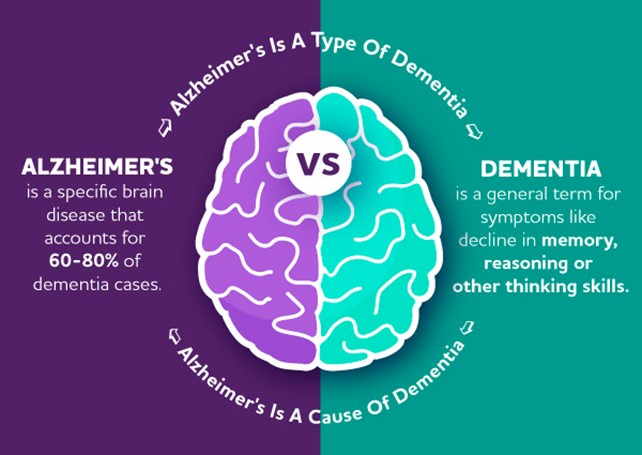
Alzheimer’s is the most common cause of dementia and accounts up to 60% of dementia cases. It is a progressive disease whereby the symptoms will gradually worsen with time. In the beginning, it may just be some memory loss. However, as the condition progresses, the dementia condition will affect one’s ability to perform tasks as well as the reasoning and thinking skills. In late-stage Alzheimer’s, the person may lose the ability to carry on a normal conversation and respond to their environment.
Click to watch Alzheimer’s Society video on Alzheimer’s Disease
Alzheimer’s Disease Classification (according to the National Institute of Aging known as NIA)
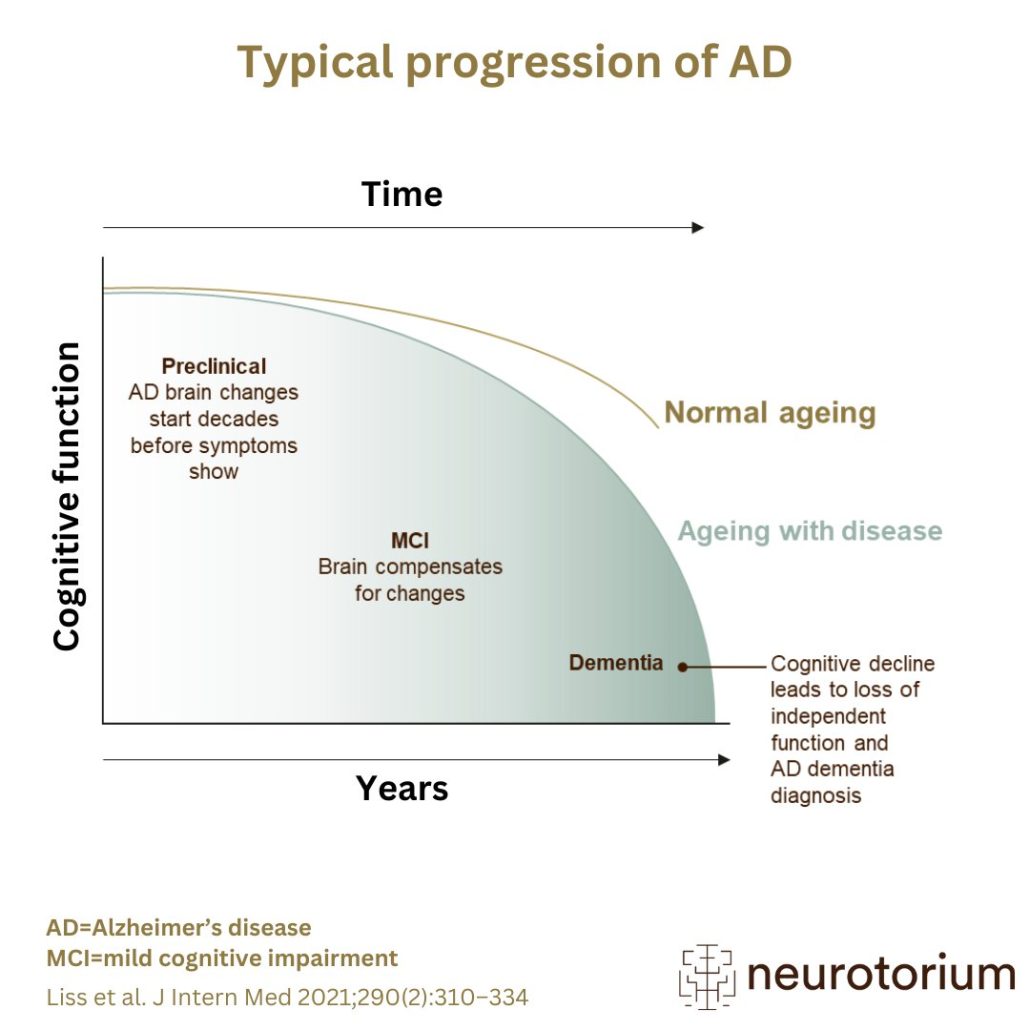
The NIA developed a guidance that focused on the three stages of Alzheimer’s disease because of increased understanding of the disease which can now be detected earlier using Biomarkers
Preclinical (presymptomatic or asymptomatic) Alzheimer’s
Mild cognitive impairment (MCI) due to Alzheimer’s
Dementia due to Alzheimer’s
Image Neurotorium
With better diagnostic testing, doctors are able to diagnose Alzheimer’s Disease in the pre-clinical stage where there may be NO symptoms at all. Even as the condition progresses with time, there may be only mild or minimal symptoms in the Mild Cognitive Impairment (MCI) stage.
Symptoms that can present at each stage of the disease
A. Mild (early stage)
In the early stage of Alzheimer’s, the person may still function independently such as driving, socializing and working. Early symptoms can be subtle. Symptoms at this stage can include;
Forgetting familiar words or locations
Difficulty remembering names of new people you meet
Difficulty performing complex tasks at work
Forgetting what has just been read
Tendency to misplace things in the house
Having trouble with planning or following instructions
B. Moderate (middle stage)
The middle-stage of Alzheimer’s can last a long time (many years) before progressing. During this stage, the dementia symptoms become more obvious. The person can still function in daily activities albeit with assistance but may find difficulty to continue working. Sometimes when they struggle, the person living with dementia may start to get frustrated or angry and react in unexpected ways. Occasionally, the person may also start to withdraw and be quieter because they can no longer follow what is going on around them. At this stage, the person may require extra care (such as closer family supervision or private nursing aide) to do the things they would normally have been able to do themselves. Other symptoms can include;
Being forgetful about recent events
Feeling withdrawn with mood swings
Confusion about time and space
Having trouble controlling their bladder or bowels or forgetting to wash or bathe
Difficulty sleeping
Tendency to wander around and becoming lost or disorientated
Suspicious or delusions about family and friends
Repetitive behaviour
C. Severe (Late Stage)
During the late stage of Alzheimer’s, the symptoms are severe. The person may lose the ability to respond to their environment and to control movement. They may not be able to communicate coherently to make themselves understood and show significant personality changes. At this stage, the patient may need a personal caregiver to attend to the daily needs. Symptoms include
Loss of physical abilities such as walking, sitting or even swallowing
Unable to look after daily hygiene such as brushing teeth, bathing or going to toilet
Difficulty communicating
Losing weight
Becoming vulnerable to infections such as bed sores and lung infections
Management of Alzheimer’s Disease
In Alzheimer’s disease, the connections between brain cells are lost due to abnormal proteins build up called ‘plaques’ and ‘tangles’ which eventually causes brain and nerve cell tissue death. Although Alzheimer’s disease has NO permanent cure, there are medications which may temporarily slow the worsening of dementia symptoms and improve quality of life.
The aim of management is to reduce the rate of progression of the disease by addressing the risk factors as well as using medication. This allows the patients to remain independent and self-caring for as long as possible.
1. Addressing the Risk Factors
Stopping smoking, reducing obesity and improving the control of any co-morbidities such as diabetes, cholesterol or hypertension can help improve blood flow to the brain. Physical activity, social contact and doing mental cognitive activities keep the mind active and can potentially reduce the rate of disease progression.
2. Medication to Treat the Symptoms
Acetylcholinesterase inhibitors such as Donepezil or Rivastigmine work by preventing the breakdown of cholinesterase enzyme in the brain. Treatment increases the amount of acetylcholine, which is a neurotransmitter essential for normal brain activity. Treatment shows improvement in memory, concentration and cognitive function in some patients.
3. Disease Modifying Treatment
Lecenemab (brand name Leqembi) is a monoclonal antibody which is given as an infusion which targets and removes beta-amyloid from the brain. It does NOT cure Alzheimer’s disease but it has been shown to slow the rate of progression in the early stages of the disease.
Click to view PennMed video on Lecanemab
Chat with a Doctor or Caregiver to discuss your health concerns
Disclaimer. TELEME blog posts contains general information about health conditions and treatments. It is not intended to be a substitute for professional medical advice, diagnosis or treatment. The information is not advice and should not be treated as such.
If you think you may be suffering from any medical condition, you should seek immediate medical attention from your doctor or other professional healthcare providers. You should never delay seeking medical advice, disregard medical advice, or discontinue medical treatment because of information on this website.
How useful was this post?
Click on a star to rate it!
Average rating / 5. Vote count:
No votes so far! Be the first to rate this post.
As you found this post useful...
Share it on social media!
We are sorry that this post was not useful for you!
Let us improve this post!
Tell us how we can improve this post?
You May Like This
Management of Migraine Management of Migraine A migraine can be described as having severe throbbing or pulsatile headache…
Brain Aneurysm Brain Aneurysm A brain aneurysm occurs at an area of weakness in an artery in…